British Army Veterinary Corps
Frederick Ulysses CARR
Lieutenant-Colonel
Died 10 November 1917 · Age recorded: 45
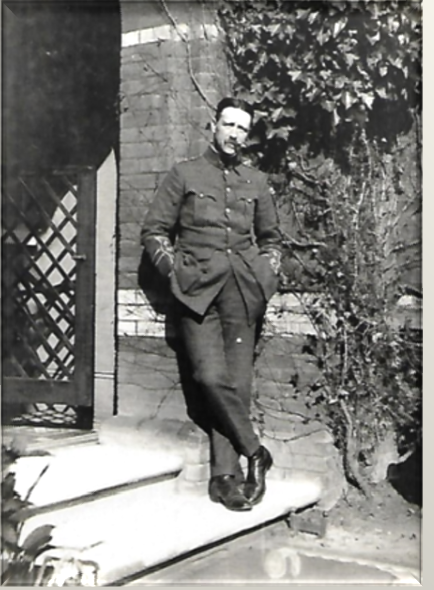
His story
Lieutenant Colonel Frederick Ulysses Carr was born in Brighouse, West Riding of Yorkshire, on 19 February 1872. He attended Clarendon House School and was later apprenticed to Parlane McFarlane Walker, a Veterinary Surgeon of Blackwall House, Blackwall, Halifax. Frederick Ulysses Carr qualified as a Member of the Royal College of Veterinary Surgeons (MRCVS) on 14 December 1893, and was then a Senior Assistant at the College until 1895.
Carr joined the Army Veterinary Department in March 1895. The London Gazette announced his appointment:
“Frederick Ulysses Carr, Gent., to be Veterinary Lieutenant, in succession to Veterinary-Captain Edward H Kelly on temporary half-pay on account of ill health, Dated 13th March 1895.”
He was immediately posted to India, serving in the Bombay Command. Lieutenant Carr returned to England on leave in 1898. At the outbreak of the Boer War in 1899, he was sent to South Africa with the Cavalry Division under the command of General French. He then served in South Africa with the Army Veterinary Department from 5 November 1899 to 1 November 1901, where he was one of the 125 military and 240 civil veterinarians who served in the country during the war.
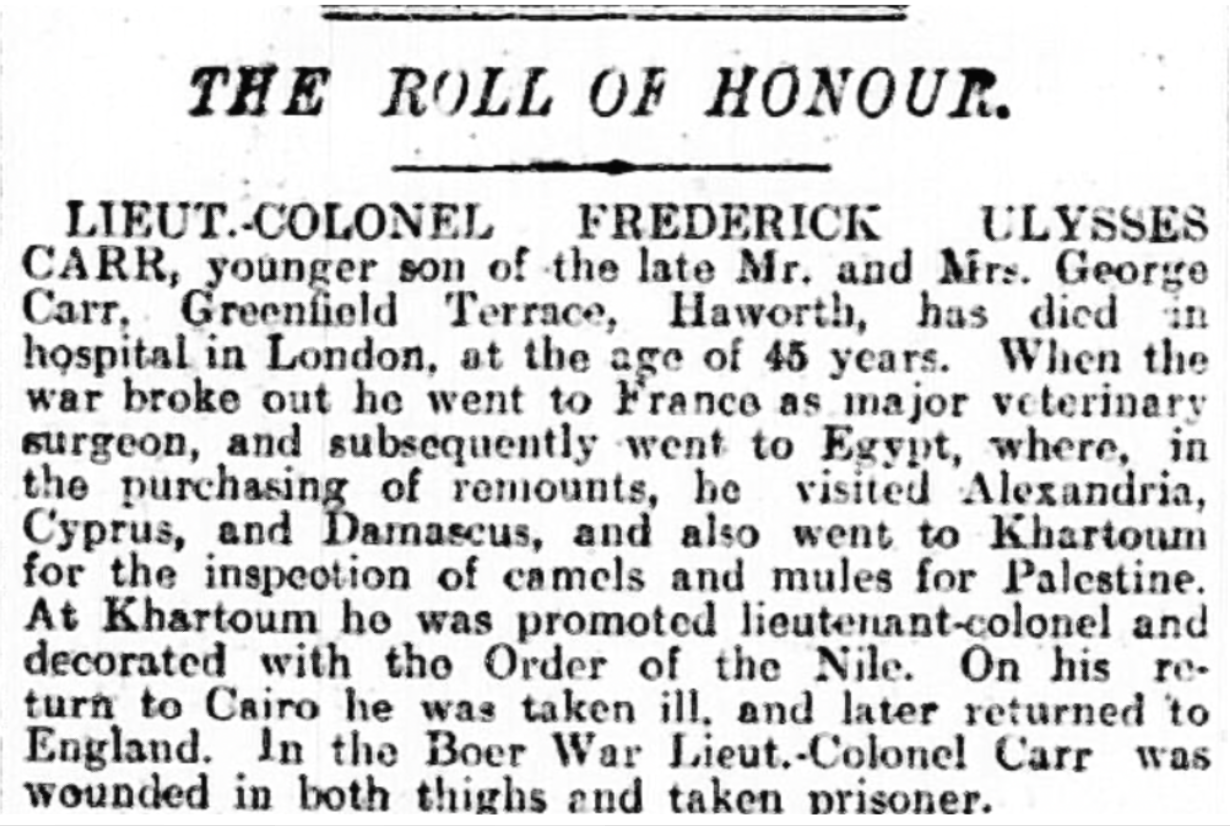
While in South Africa, Carr’s horse was shot from under him; he was severely wounded in both thighs and was taken prisoner. Eventually, the Boers allowed him to return to the British lines and provided him with a Boer pony. Back with his British comrades in Uniondale, he spent a considerable amount of time in the hospital. He was evacuated back to Britain on 1 November 1901. For his service in South Africa, Lieutenant Carr was rewarded, on 11 November 1902, with the Queen’s South Africa Medal. He gained six clasps, all of which were for involvement in specific actions rather than for simple presence in an area for these medals.
Carr returned to South Africa and then went to Australia with the British Army Remounts Commission in late 1901 and early 1902. He later served in Nigeria and the Sudan.
With the outbreak of war, Carr arrived in France on 16 August. Only nine days after landing, on 25 August, he was taking part in the retreat from Mons of the British Expeditionary Force. He was later present at the (First) Battle of the Marne on 7-10 September 1914 and was then involved at the Battle of the Aisne from 12-15 September. At the Aisne his horse was again shot from under him, and he was badly wounded. After a period of recovery and consequent on a request of the Commander in Chief of the Egyptian Army (who had given permission for him to rejoin the British Army only two months previously), he was again seconded for service with the Egyptian Army, effective 17 October 1914. On 15 December 1915, Major F. U. Carr was promoted to Temporary Lieutenant-Colonel.
In February 1917, Carr became ill and spent 12 weeks in Cairo Hospital. Carr was transferred from Egypt to the 3rd London General Hospital at Wandsworth, where he arrived on 5 November 1917. He died on 10 November 1917, aged 45. The Egyptian Army removed him from its strength on 9 December 1917. His death certificate gives his address as Greenfield House, Keighley and the cause of death as Tuberculosis.
Lieutenant Colonel Carr had obituaries in the Veterinary Journal and the Veterinary Record.
Photographs and documents
Before the war
- Nationality
- British
- Date of Birth
- 19 February 1871
- Place of Birth
- Brighouse, Yorkshire, England
- Veterinary College and Date of Graduation
- London - December 1893
Military service
- Last Rank
- Lieutenant-Colonel
- Regiment/Service
- British Army Veterinary Corps
- First Theatre of War
- France 1914
Medals and commemoration
- Name on RCVS Honour Board
- Yes
- Name In Officers who died in Great War
- Yes
- Medals and Awards
- British War Medal 1914-1918; Victory Medal
Death and burial
- Date of Death
- 10 November 1917
- Age at Death
- 45
- Place of Death
- London, England
- Cause of Death
- Tuberculosis
- Cemetery
- Haworth (St. Michael) Churchyard
- Location
- Haworth, Yorkshire, England
- Grave Reference
- 741
- Commonwealth War Grave
- Yes - Private Headstone
Sources and further reading
- CWGC casualty and commemoration record
- Find a Grave memorial
- The Veterinary Record — obituary of Frederick Ulysses Carr (issue not specified in retained biography) — cited in the earlier biography
- The Yorkshire Post November 19,1917 — reproduced document
Cite this biography
Graham Hodgkins and Pete Matthews, “Frederick Ulysses Carr”, Veterinary Virtual War Memorial, https://vetsremembered.org/people/frederick_ulysses_carr/.
Contribute information
Can you add a letter, family photograph or document that tells us more about his life before service? Please give its source and any permission needed for display.